The short version
Run a mystery. Invite six to eight friends, split them into two teams, and give each team a case that ends at a locked box with the cake behind it. Add a warm-up puzzle on arrival, a break for food and a reveal, two hours from the first arrival.
The change at nine is that they can finally solve things for themselves. Give them clues they can crack in a few minutes, a clock they can see and a hint card for a team that is stuck, and the party runs on their effort rather than yours.
What nine year olds want from a party
A story, a team and a puzzle that is hard enough to be worth the win.
A nine year old can read a clue, hold three facts in mind and work with a partner without taking over. They like secrets, codes and the feeling of being the one who worked it out. They also notice when something is babyish, so skip the parlour games and give them a real task. A case with a time limit does that better than any bouncy castle.
For how nine sits next to eight and ten, the birthday party ideas by age guide has them side by side, and the 8 year old birthday party ideas cover the challenge course that nine can also enjoy.
Building the case: story, chain and lock
A mystery party has three parts, and you can write all of them in an evening.
First the story: one paragraph, read aloud by a parent in character. The cake has been stolen, the birthday child is the detective, and the thief left five clues. Second the chain: each clue leads to the place of the next, so the teams move through the house in order and no one can skip ahead. Third the lock: the last clue gives a code for a small box, and the box holds the cake knife or the candles.
Two teams solve the same case from different first clues, so they never crowd the same cupboard. Mix the teams on purpose, with friends split across them, and tell the children how they were chosen as a fact, not a vote.
| Job | Who does it | How it works |
|---|---|---|
| The story | A parent, in character | One paragraph, a funny voice and a clock on the table. It sets the stakes and costs nothing. |
| The chain | You, the night before | Five to seven clues in two matching routes, each one hidden where the last one points. |
| The lock | A box with a code | A cheap combination box or a taped box with a paper code. The final answer opens it. |
| The hints | The host | A team stuck for three minutes may ask for a hint card. Hints cost nothing but a little pride, and no team is left stuck. |
| Safety and snacks | A second adult | One adult follows each team, stays quiet and keeps the doors and stairs safe. |
Send the invitation three to four weeks out and write it as a case file. The invitation wording guide has the sentences, and the four week birthday party checklist covers the rest of the order.
The stuck teamEvery mystery has one. Do not hand over the answer. Give a hint card with a smaller question, such as which room has a window and a plant, and let them make the last step themselves. Children remember the clue they cracked, not the one they were told.
Six puzzles a nine year old can really crack
Mix two or three of these in each chain, and test every one on an adult who has not seen it.
- A simple cipher. Each letter becomes the next one in the alphabet, with the key written on the thief's note. Short words only, and a five minute puzzle at most.
- A hidden word. A few lines of text where the first letter of each line spells the place of the next clue. It is a puzzle a child feels clever for spotting.
- A mirror message. A clue written backwards that reads properly in a hand mirror held beside it. It needs no code and is satisfying.
- A number lock. A four digit code built from facts they find in the house, such as the number of windows in the lounge. Make the digits add up so a team can check themselves.
- A logic card. Three suspects, three clues and one answer. Who was in the kitchen, who has muddy shoes, who is left-handed. A pair can solve it with a pencil.
- A jigsaw clue. A note cut into six pieces and hidden in six places. It sends the team round the room and puts the pieces together at the end.
For a route that works in a small house, the birthday scavenger hunt ideas have the clue placement, and you can swap the hunt's pictures for the puzzles above.
The test for any puzzleCan a pair solve it in five minutes with a hint? If yes, it works at nine. If it needs an adult every time, replace it with something shorter.
The night before: setup a parent can do at home
Plan on an hour, a pen, a few envelopes and the cake box.
Write the clues on paper in plain handwriting, number the envelopes on the back and tape each one where the clue before it points. Walk both routes yourself with a timer, and fix any clue that took you more than a minute to find. Put the combination box, the hint cards and a pencil for each team on a tray by the door.
Keep the rooms the children will use clear, and close the ones they should not. Mark the stairs and any room with breakable things as out of bounds on the story sheet, as part of the game. Nine year olds follow a rule much better when it belongs to the story.
The rushDo not hide clues on the morning of the party. A clue that is out of place by one shelf can end a route, and you will not have time to repair it. Do the whole setup the night before, then walk it once more with a cup of tea.
A 120 minute plan for a 9th birthday party
Two hours, one mystery and a long stretch of eating and talking about it.
| Time | What happens | Why there |
|---|---|---|
| 0:00 to 0:15 | Arrivals, parents wave goodbye, a warm-up puzzle on the table | Guests arrive over fifteen minutes. A mirror message or a cipher gives each one something to crack at once. |
| 0:15 to 0:25 | The story is read, teams are announced, the clock starts | Read the case once, set the teams and hand out the hint cards. |
| 0:25 to 1:10 | The mystery: both teams work through their chain | Energy and attention are at their highest. Forty five minutes is the longest a mystery holds. |
| 1:10 to 1:20 | The last lock opens and the case is solved | Both teams reach the box at nearly the same time, because you built two matching routes. |
| 1:20 to 1:45 | Food and the story of how each team cracked it | Sit-down time. They want to tell you how they did it, so let them. |
| 1:45 to 1:55 | Cake, the song and a detective badge each | The cake was the thing they were hunting for, so it arrives as the prize for both teams. |
| 1:55 to 2:00 | Bags, goodbyes and pickup | Hand each child over to a named adult. Keep coats near the door and the end clear. |
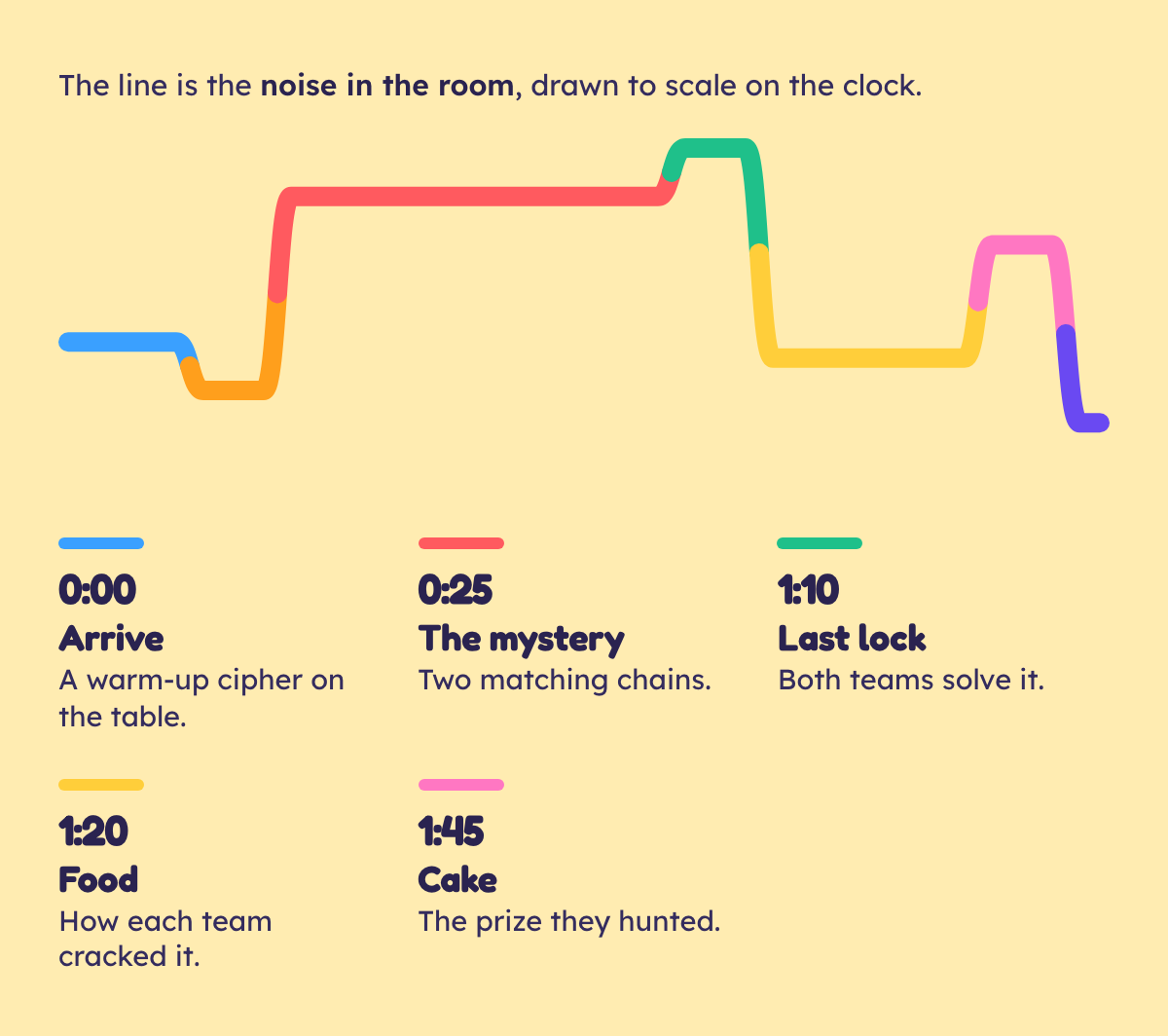
For a shorter party or a longer one, the same logic stretched or squeezed is in the kids birthday party schedule.
The guest list: teams that work
Six to eight guests, and an even split, so the two routes run in step.
Ask your child who they want, write the names down and look at the list as a parent of the child who is not on it. Eight children make two teams of four, and six make two of three. At nine there are best friends, and a pair who are always together will solve fast and leave the others behind, so split them and say so at the start.
Nine year olds are also starting to care how a party looks to others. A mystery helps, since the case is the point and nobody is performing. If the whole class is coming, run it in a hall with three or four routes and a second adult for each, and keep the story the same.
The fast teamOne team will finish first. Make sure the lock is the same on both routes and that the last clue cannot be solved without the other team's code word. Both teams then open the box together, and nobody gets to win by being quicker.
Food, cake and the party bag
Keep all three simple, and tie them to the story.
Food. Finger food on a plate, with no assembly. Sandwiches, fruit, crisps and something warm if you can. Check allergies on the invitation, since parents who drop off will not be there to ask, and write them on a card next to the food. Keep drinks to water and one juice.
Cake. One cake, candles lit once and a song. It sits behind the final lock, so the case ends with the thing they have been working for.
The bag. A detective badge, a small notebook and a pencil, and a copy of the cipher key so they can send a secret message on Monday. For more games to have on hand, thirty birthday party games sorted by age has the eight to ten list.
Run or step back? Be the host, not the solver. You read the story, keep time and hand out hints, and then you step back and let the teams argue it out. A mystery goes well when the adults are the clock and the voice, and the children are the detectives.
Questions parents actually ask
What do you do at a 9 year old's birthday party?
Run one mystery with a clue chain that ends at the cake, in two teams. Add a short warm-up puzzle on arrival, a break for food and a final reveal. Nine year olds like puzzles they have to work for, a clock and a story, so build the party around a case to solve. Keep it to about two hours.
How do you run a mystery or escape room party at home?
Write a short story, hide five to seven clues in a chain so each one leads to the next, and lock the last one behind a code. Use a cheap combination box or a locked box with a paper code. Two teams solve the same case from different starting clues, and a parent plays the host who hands out hints.
How many kids should you invite to a 9th birthday party?
Six to eight. Teams of three or four can share a puzzle without one child taking over, and a room of eight children is still easy to supervise. More than ten and some will wait while others solve.
How hard should the puzzles be for a 9 year old?
Hard enough to need two minds and easy enough to crack in five minutes. Use codes, ciphers with a key, hidden words and simple logic, with a hint card for any team that is stuck for three minutes. A puzzle nobody solves is a bad puzzle, not a hard one.
How long should a 9 year old's birthday party be?
Two hours. A mystery runs for about 45 minutes, and the rest is arrival, food and cake. End while the story is still fresh.