The short version
Yes, a screen can belong at a birthday party, as long as it is one shared screen that drives a group activity. The line is between passive use, where each child watches or plays alone, and active use, where the screen sets a challenge and the children solve it together, out loud, often off the couch.
One television, teams, a short session with a clear end, and challenges that send children into the room rather than into the device. That is a party game. Six tablets in six laps is not.
Two kinds of screen at a party
Most parents worry about screens at a party for a good reason. They have seen what happens when a group of children are each handed a device: the room goes quiet, and not the good kind of quiet.
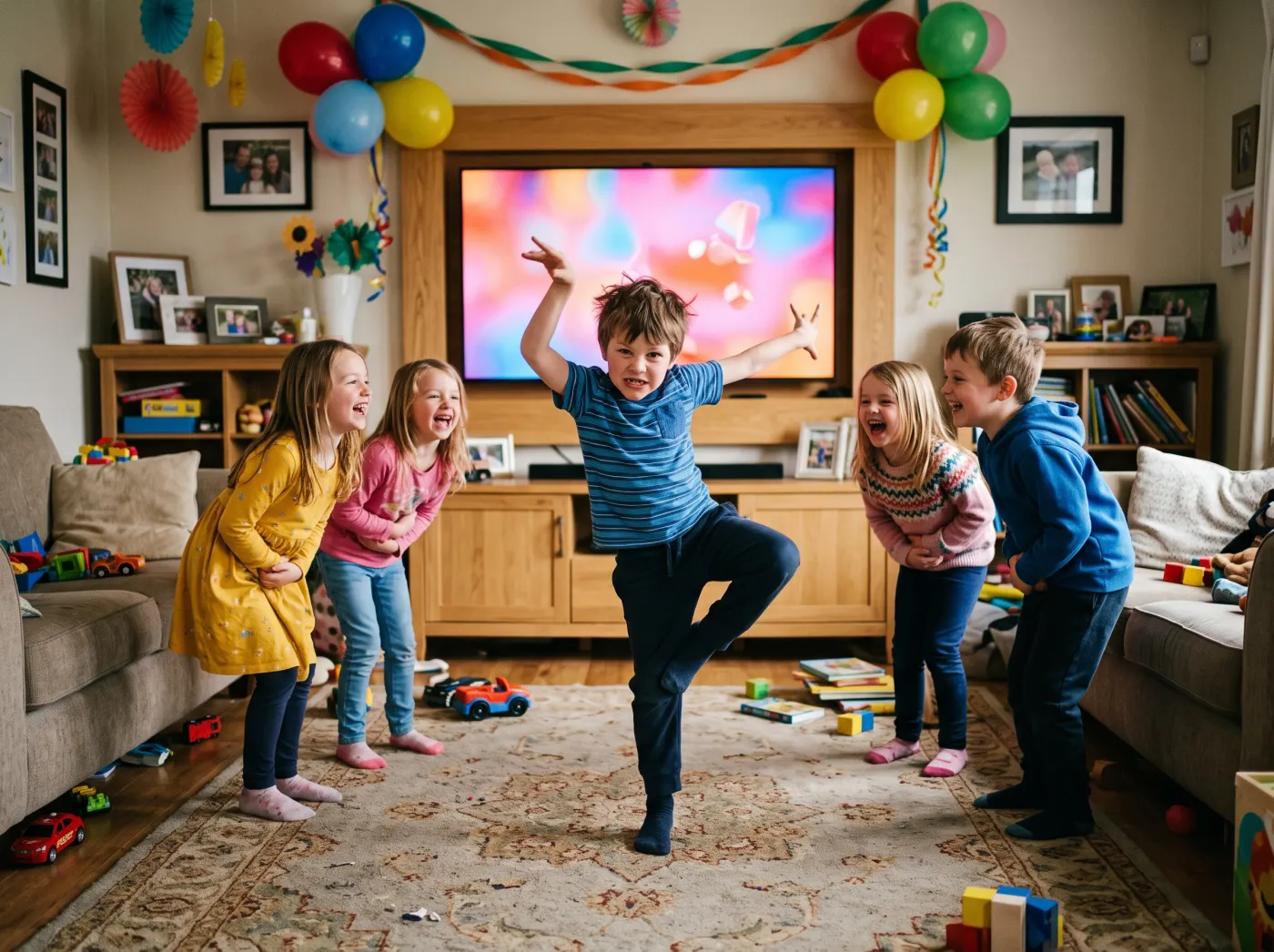
But that is one use of a screen, not the only one. A television showing a quiz that two teams are arguing over is closer to a board game than to a tablet. The screen is the board. The game happens between the children.
| Question | Passive | Active |
|---|---|---|
| How many screens | One per child | One for the room |
| Where children look | Down, at their own device | Up, at the screen and each other |
| Who talks | Nobody, or the device | Everyone, at once |
| Does anyone move | No | Often: find, fetch, act out, run |
| How it ends | When an adult takes it away | When the game ends |
The question is not whether there is a screen in the room. It is whether the children are looking at it or at each other.
The five point test for a party screen game
Before you put anything on the television, check it against these five. A game that passes all five is a party game that happens to use a screen.
- One shared screenThe television or one tablet propped up where everyone can see it. Not a device per child.
- It needs more than one childThe challenge is solved by a team, talked through, argued over. If one child could play it alone, it is not a party game.
- It sends them into the roomFind something, act something out, fetch three things that are red, hum a song for the team to guess. The best screen games are mostly off screen.
- It has a clear endA fixed number of rounds or a finale. A game that ends by itself never needs an adult to switch it off.
- It is about the people in the roomQuestions about the birthday child, challenges named after guests. Personal content keeps attention on the group rather than on the screen.
How to run a screen game at a party
Treat it like any other main game: a slot in the schedule, a start, and an end.
- Place it after food. The thirty minute main game block after snacks is where a group is settled enough to sit for a round and restless enough to want to move. The party schedule shows where it falls.
- Set it up before guests arrive. Open it, check the sound, check it fills the screen. Nothing kills a room faster than an adult kneeling by the television looking for a cable.
- Make the teams yourself. Mix friend groups and ages. Say the teams as a list, not a pick.
- Give one child the controller. The birthday child, or a rotating reader. The adult starts it and steps back.
- Keep it to twenty or thirty minutes. Long enough to build a score, short enough to end while they want more.
- Plan the next thing. Cake, outside, a hunt. A screen game that hands over to something physical is how the party keeps moving.
Check it works without internetLiving room wifi with twelve phones on it is not the network the game was tested on. A game that loads once and then needs nothing more from the connection is one less thing to fail on the day.
What changes with age
| Ages | What works | Who reads |
|---|---|---|
| 5 to 7 | Picture prompts, movement challenges, very short rounds | An adult reads aloud |
| 8 to 10 | Codes, clues, team points, find-it challenges | A different child each round |
| 11 to 12 | Quiz rounds about the group, fast timers, voting | The birthday child runs it |
| 13 to 15 | Room-wide voting, trivia about friends, inside jokes | Them. The adult leaves |
For the games either side of the screen slot, the thirty birthday party games are sorted by age and by the moment in the party they fix.
Guests and their own phones
By ten or eleven, most guests arrive with a phone. You do not need to confiscate them. You need a reason they stay in pockets.
A basket by the door works for some groups and feels like school to others. What works for every group is an activity that is better than the phone: loud, social, and about them. Phones come out for photos at the cake, which is fine. If phones come out during the game, the game is the problem, not the phones.
What goes wrong, and the fix
- Two children play, eight watchThe game is single player in disguise. Switch to teams and give every round to a different child.
- It will not loadTest it on the actual television the morning of the party, on the home network, with the sound on.
- Nobody wants to stopThat is a good problem. Let the last round finish, then go straight to cake so the end is a handover rather than a removal.
- The youngest cannot keep upPair them with an older reader, or use challenges with pictures and actions rather than text.
Questions parents actually ask
Is screen time OK at a kids birthday party?
Yes, when it is one shared screen running a group game rather than a device per child. A team game on the television that sets challenges children solve together, talk through and often act out in the room is social play, not the passive screen time most parents want to avoid.
What is the difference between active and passive screen time?
Passive screen time is watching or playing alone, eyes down, with little talk or movement. Active screen time uses the screen to prompt something in the real world: a team discussion, a physical challenge, a search around the room. At a party, active use is the kind that brings children together.
What games can kids play on the TV at a birthday party?
Team quizzes about the birthday child, picture and charades prompts, code and clue challenges that send teams around the house, room-wide voting games and personalised birthday games built around the child. The best ones need more than one child to solve and end on their own.
How long should a screen game last at a kids party?
Twenty to thirty minutes, as the main game slot after snacks. That is long enough to build a score and short enough to end while the group still wants more, then hand over to cake or something physical.
Should I take guests' phones at a birthday party?
Usually not. A basket by the door can work, but the more reliable fix is an activity that is better than the phone. If guests reach for phones during a game, the game is too slow or too single player, so change the game rather than the rule.
How do I stop a screen game isolating kids at a party?
Use one shared screen, make teams, rotate who reads or controls it, choose challenges that send children into the room, and keep the content about the people there. Those five things turn a screen into a game board rather than a wall.